Environmental Regulation, Firms, and Trade: Evidence from Mexico’s Air-Quality Programs
Abstract
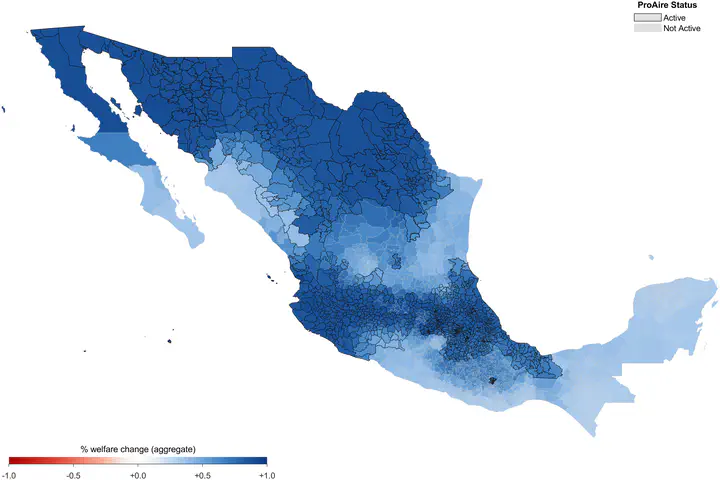
Air quality regulations often target pollution where exposure is highest, creating spatial differences in both compliance costs and environmental benefits. This paper studies one such intervention, Mexico’s ProAire air-quality programs, and their effects on manufacturing emissions, firm trade, and consumer welfare. I combine the staggered rollout of ProAire across municipalities from 2011 to 2020 with linked firm-level data. I first show that the decline in Mexican manufacturing emissions intensity between 2005 and 2018 was driven mainly by within-industry technique changes, which account for 88 percent of the reduction. After ProAire adoption, reported CO2 emissions among RETC-reporting firms fall by 11 percent. Trade adjustment occurs primarily through the extensive and intensive margins of exporting. Export entry changes little, export exit rises by 2.8 percentage points, and export sales among continuing exporters fall by 9.5 percent, while imports among continuing importers rise by 18 percent. I then evaluate the welfare implications of spatially targeted regulation through a quantitative spatial model with heterogeneous firms, pollution-intensive production, international trade, atmospheric transport, and worker sorting. I find that ProAire lowers output by 0.07 percent, while welfare rises by 0.099 percent.